
Shot Scope LM1:
Birdie Or Bogey?
It looks like a winner. But can a $200 launch monitor deliver the numbers golfers actually need?
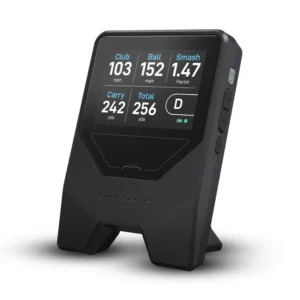
I love the idea of a quality launch monitor at an affordable price. That’s why I wanted the Shot Scope LM1 to be good. It’s sleek, modern, and looks the part. Unfortunately, for my practice needs, that’s about where the praise ends.
The LM1 gives you a useful general sense of speed, but I found it too inconsistent for precise swing-to-swing comparisons. And without comprehensive measured ball-flight data, its distance numbers are far less informative than I’d hoped.
Ball speed: Close isn’t always good enough
In my experience, the LM1’s ball speed readings were generally within 2–3 mph of the actual value. That might sound acceptable for a budget device, and it can be enough to tell you your approximate ball-speed range.
But the errors went in both directions: sometimes high, sometimes low. If one swing reads faster than another, how confident can you be that you actually gained speed? That inconsistency limits its usefulness for speed training, equipment comparisons, or testing small swing changes.
Distance: A calculation, not a complete picture
The LM1 displays carry and total distance, but it does not report measured spin or launch-angle data to the golfer. Its distance outputs rely on proprietary processing rather than the detailed measured ball-flight information available on premium monitors.
Spin matters. Two shots with similar ball speeds can fly very differently because of spin and launch conditions. If you’re evaluating a driver, comparing golf balls, or trying to understand why one iron shot carries farther than another, a simple distance estimate can hide the very information you need.
Shot Scope has described its proprietary radar-based distance estimation differently from a basic fixed-spin assumption, so I wouldn’t claim to know its exact internal formula. My practical criticism remains: without accessible spin and launch data, you cannot diagnose the flight in detail.
Spin seems to be almost entirely based on the club you select when setting up the LM1. If you select a wedge but hit driver, you’ll see the Carry Distance as longer than the Total Distance, implying that your ball checked up and spun back. That would only happen if it was calculating spin based on your club selection and not actually capturing spin data.
Club speed: Hard to trust smash factor
I also struggled to get consistently convincing club speed readings, particularly when the unit appeared to have trouble reading the back of the club. That matters because smash factor is ball speed divided by clubhead speed . If either input is unreliable, the ratio becomes questionable too.
For me, that makes the LM1 a poor tool for evaluating strike efficiency or tiny changes in contact quality.
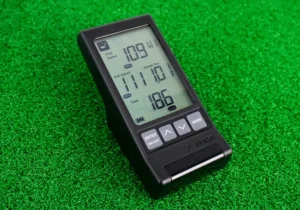
It’s really just a better-looking PRGR…
That was my lasting impression. The LM1 has a much more polished screen and presentation than the PRGR, but I didn’t find enough additional actionable insight to make it feel like a major step forward.
Where I’d rather spend the money…
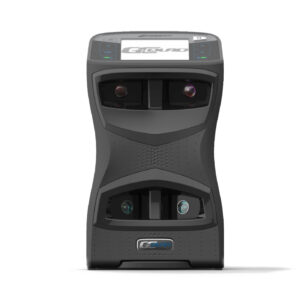
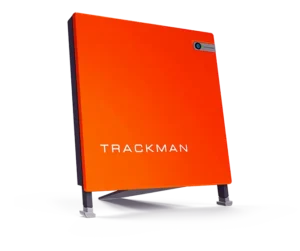
My preferred option? Put that $200 toward practice time in a simulator with a professional system such as the Foresight GCQuad or TrackMan . These systems provide much more detailed ball-flight measurements, including spin, and club-delivery information that can guide real changes.
A few productive sessions with quality equipment can tell you more than repeatedly guessing whether a small change on a budget display was real.
BOGEY – 3/10.
I wanted the Shot Scope LM1 to deliver affordable, meaningful golf data. Instead, I got a great-looking device with speed readings I didn’t trust enough for close comparisons and distance estimates that couldn’t explain ball flight.
For my money, $200 is better spent on time in a simulator with a professional launch-monitor.
The LM1 has a big promise, but for me, it underdelivers.
Reviewer’s note: Accuracy observations reflect the reviewer’s personal experience, not a published controlled test. Other testers may have reported different results. The LM1 does not display launch angle or spin as user-facing metrics; the manufacturer’s exact distance algorithm is proprietary.